
For biologics developers, selection strategy directly affects cell line development timelines, clone quality, productivity, and long-term manufacturing stability. DHFR/MTX and GS/MSX selection have both played important roles in CHO-based biologics manufacturing, but they differ significantly in workflow burden, selection stringency, and dependence on host-cell background.
This article compares the two systems and explains why double GS knockout CHO-K1 platforms, including Demeetra’s CleanCut GS CHO, offer a more stringent and streamlined path to stable, high-producing pools and clones.
| Selection System | Strength | Main Limitation | Demeetra Relevance |
|---|---|---|---|
| DHFR/MTX | An established amplification system with long use in CHO cell line development | Time-intensive and associated with copy-number instability when selective pressure is removed | Provides a useful contrast for modern CHO platform positioning |
| Traditional GS/MSX | Faster metabolic selection that can reduce dependence on prolonged stepwise amplification | Endogenous GS activity in CHO cells can reduce selection stringency | Explains why GS knockout host engineering matters |
| Double GS knockout | Stronger glutamine dependence and more stringent enrichment of productive cells | Requires precise host-cell engineering | Supports CleanCut GS CHO differentiation as a next-generation selection platform |
DHFR/MTX Selection: Powerful, but Time-Intensive and Stability-Limited
DHFR/MTX selection has been a workhorse for stable CHO cell line development, but the workflow carries real tradeoffs. Stepwise methotrexate (MTX) amplification is time-consuming, and the instability it introduces is well documented: amplified copy number can collapse when selective pressure is removed.
Mechanistically, Baik et al. demonstrated that MTX-driven DHFR inhibition depletes nucleotide pools, generating DNA double-strand breaks and extensive chromosomal rearrangements during amplification. That genomic disruption is part of why DHFR/MTX workflows may require extended screening and stability evaluation.
The DHFR-deficient host background adds another consideration. CHO-DG44 and CHO-DXB11 remain widely used, but comparative omics analyses have indicated that both carry relatively less active metabolic profiles than CHO-K1. This is part of the rationale for developing modern selection platforms directly in high-performance CHO-K1 backgrounds.
Why GS/MSX Selection Can Shorten CHO Cell Line Development
The glutamine synthetase (GS) system offers a more direct metabolic selection strategy. GS catalyzes glutamine synthesis from glutamate and ammonia, enabling cells to survive in glutamine-free conditions when sufficient GS activity is present.
In GS/MSX selection, cells are grown under conditions that pressure them to rely on a GS-linked expression cassette associated with the gene of interest. Compared with DHFR/MTX amplification, GS-based selection can reduce the need for prolonged stepwise amplification and shorten the path to stable pools and clones. Published work describes GS selection as more efficient than DHFR/MTX because it can generate stable cell lines on a shorter timeline.
Why Endogenous GS Activity Limits Traditional GS/MSX Selection
Traditional GS/MSX selection is not always maximally stringent because CHO cells retain endogenous GS activity. In practical terms, endogenous GS can create an escape route: cells may survive glutamine-free selection without being fully dependent on the introduced GS-linked expression cassette.
This is why GS knockout hosts are valuable. Removing endogenous GS increases the cell’s dependence on the introduced cassette, improving the selection pressure used to enrich productive, stably integrated populations. Prior GS knockout studies showed improved selection stringency and enrichment of high producers, and more recent genomic work identified an additional GS-like locus that can affect selection performance.
Double GS Knockout CHO Cells Increase Selection Stringency
Limia et al. addressed the residual stringency problem by targeting both GS loci in suspension-adapted CHO-K1 cells: the primary GS gene on chromosome 5 (GS5) and a homologous pseudogene on chromosome 1 (GS1). Single GS5 knockout leaves an escape route, as GS1 can be upregulated to compensate, as demonstrated independently by Srila et al. using CRISPR/Cpf1. Eliminating both loci closes that escape and increases dependence on the introduced selection cassette.
In the Limia et al. study, Demeetra used Cas-CLOVER, a high-fidelity dual-guide nuclease, to edit both loci with chromosome-specific precision. Because Cas-CLOVER functions as a dimeric system, it can be designed to distinguish between highly homologous gene sequences based on guide-pair positioning and local sequence differences. In this case, the guide-pair design enabled sequential, locus-specific targeting of GS5 and GS1 despite their high similarity. Cas-CLOVER achieved 84% editing at GS5 and 74% editing at GS1, outperforming Cas9 under the tested conditions.
This precision is central to the double-knockout strategy because it allows each GS locus to be edited intentionally rather than relying on less specific disruption across similar sequences. In the study’s off-target analysis, whole genome sequencing evaluated 10 predicted off-target sites per guide RNA, covering 40 potential off-target sites across the guides used for GS5 and GS1 editing. No off-target edits were detected at those evaluated sites.
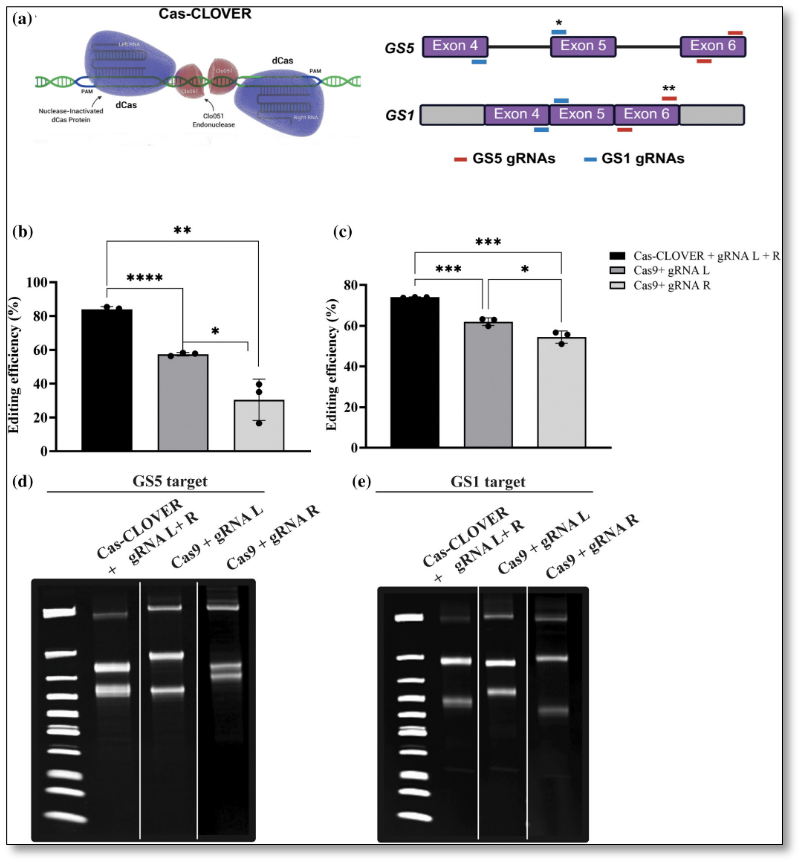
Cas-CLOVER enabled efficient, chromosome-specific editing of both GS loci in CHO-K1 cells.
Figure 1 from Limia et al. Cas-CLOVER efficiently edits both GS loci in CHO-K1 cells. Cas-CLOVER editing strategy targeting the primary glutamine synthetase gene on chromosome 5 (GS5) and the GS pseudogene on chromosome 1 (GS1) in suspension-adapted CHO-K1 cells. Editing efficiencies were compared with Cas9 using T7EI mismatch assays 72 hours post-transfection. Cas-CLOVER achieved higher editing efficiencies at both loci, supporting the generation of GS5 single-knockout (GS5-SKO) and double-knockout CleanCut GS CHO cells (GS-DKO). Data shown as mean ± SD from biological triplicates.
The functional difference between single and double knockout was clear. In glutamine-free medium, GS5 single-knockout clones were eliminated by day 9, whereas GS double-knockout clones were eliminated by day 6. That faster loss of viability in the absence of glutamine supports a more stringent selection window: cells that fail to acquire a stable GS-linked expression cassette are removed more rapidly, enriching for productive, stably integrated populations. This distinction matters because single GS knockout hosts may still retain a compensatory escape route, while CleanCut GS CHO is engineered to remove both GS-associated loci and create a more stringent selection environment.
CleanCut GS CHO Enables Faster, Stable Pools and Higher-Producing Clones
Demeetra further validated CleanCut GS CHO by combining the double GS knockout host with the Harbor-IN transposase system to generate stable trastuzumab-producing CHO pools and clones.
In Limia et al., the GS single-knockout pool produced 1.65 g/L trastuzumab with a cell-specific productivity of 55.2 pg/cell/day. By comparison, the CleanCut GS double-knockout pool reached 4.21 g/L with 83.9 pg/cell/day. Top CleanCut GS-derived single-cell clones produced 5.6 g/L and 5.3 g/L, with Qp values of 109.4 and 108.4 pg/cell/day, respectively.
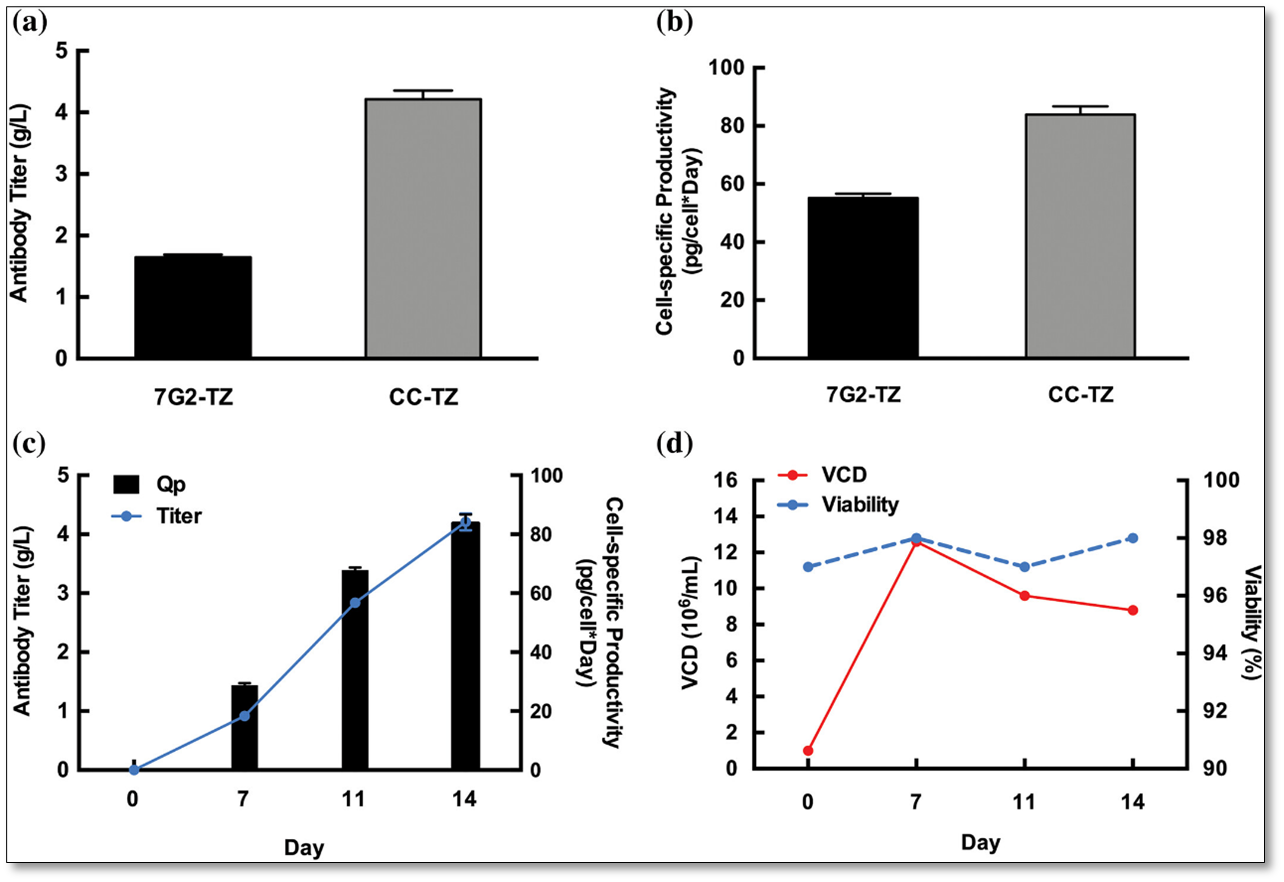
CleanCut GS double-knockout pools showed higher trastuzumab titer and cell-specific productivity than GS single-knockout pools in the study.
Figure 4 from Limia et al. Enhanced productivity of Demeetra’s CleanCut GS CHO platform. Comparison of trastuzumab-producing pools generated using a chromosome 5 single glutamine synthetase knockout (GS5-SKO, 7G2-TZ) versus Demeetra’s double knockout CleanCut GS CHO cells (GS-DKO, CC-TZ; knockout of GS on chromosome 5 plus the GS pseudogene on chromosome 1). Panels show (a) day 14 antibody titer, (b) day 14 cell-specific productivity (Qp), (c) productivity profile of the CleanCut GS pool across culture duration, and (d) viable cell density (VCD) and viability over time.
The platform also demonstrated production stability. Limia et al. reported that CleanCut GS CHO pools and clones maintained high antibody production across 60 generations, with transgene insertion numbers remaining consistent across later passages. From a development workflow perspective, this stability enables teams to generate early-phase study material from bulk pools, including material to support downstream process and analytical development, while single-cell cloning and clone characterization proceed in parallel. That parallel path can help reduce the timeline from cell line development to GMP or clinical material.
Explore how CleanCut GS CHO supports faster, more stringent.
CHO cell line development.
What This Means for Biologics Manufacturing
For teams developing recombinant antibodies and other biologics, the selection system is not just a technical detail. It can influence how quickly stable pools are generated, how efficiently high-producing clones are enriched, and how much confidence teams have in production stability across development.
Rather than relying on prolonged MTX-driven gene amplification in DHFR-deficient hosts, CleanCut GS CHO uses precise Cas-CLOVER editing to remove both GS loci in a CHO-K1 background. The resulting double-knockout host creates stronger glutamine dependence, enabling faster removal of nonproductive cells and more efficient enrichment of stable, high-producing pools and clones. The study also reinforces the precision story, with no off-target edits detected at the evaluated predicted off-target sites.
When paired with Harbor-IN stable integration, CleanCut GS CHO provides a streamlined platform for high-titer antibody production with demonstrated stability across extended passaging. For biologics developers, that combination supports a more efficient path from stable pool generation to clone selection and later-stage manufacturing readiness.
References
Baik et al. (2021). Targeted Gene Amplification on Chromosome 1 in Chinese Hamster Ovary Cells Revealed by CRISPR/Cas9. Pharmaceutics, 13(3), 376. https://doi.org/10.3390/pharmaceutics13030376
Srila et al. (2023). Glutamine synthetase (GS) knockout (KO) using CRISPR/Cpf1 diversely enhances the selection efficiency of CHO cells expressing therapeutic antibodies. Scientific Reports, 13, 11837. https://doi.org/10.1038/s41598-023-37288-6
Limia et al. (2026). Sequential, chromosome-specific glutamine synthetase double knockout with Cas-CLOVER establishes enhanced CHO platforms for cell line development. Biotechnology Progress. e70113. https://doi.org/10.1002/btpr.70113